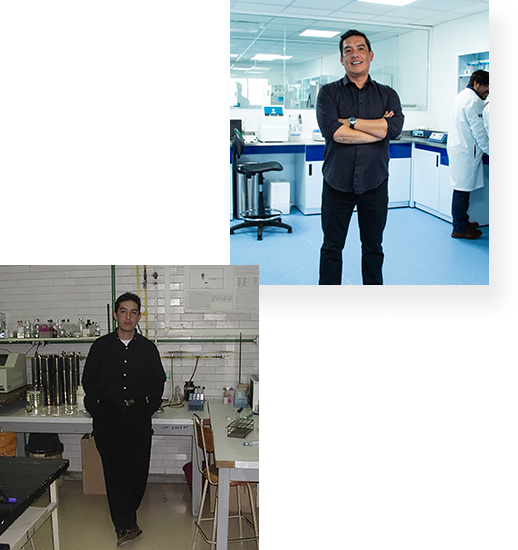
In the late 1980s, I found a way to channel my need for expression, from school plays to national children's poetry contests. Later, in the 1990s, as a substitute actor, I had the privilege of sharing the stage with renowned actress Ofelia Gilmaint. My restless spirit led me to the Mexican Rock scene in the early '90s, where I got involved in various aspects of live show production for different bands. It was here that I understood that business isn't just about making money—it’s about creativity, innovation, and discipline. However, science called me back, and I began as an auditor at the medical school in Ciudad Universitaria for two years. Afterward, I decided to study Biology. Under the mentorship of Dr. Sergio Vaca Pacheco, I realized this was my path. From that moment, I immersed myself entirely in the laboratory. Evidence of this is that, even before graduating with a degree in Biology from the FES Iztacala at UNAM, I had already published six scientific articles. I continued my studies at Linköping University in Sweden and later at the Karolinska Institute, where I obtained a Ph.D. in Molecular Epidemiology and Infection Biology, as well as certification in Biosafety.
After returning to Mexico, I realized there was still much work to be done. However, we have all the tools to ensure that our scientific work has a positive and effective impact on the lives of all Mexicans.
Upon completing my studies, I became a researcher and lecturer at UNAM. From 2008 to 2010, I served as a biosafety advisor to the Swedish Ambassador in Mexico.
In March 2009, Mexico was the first country to notify the World Health Organization about an outbreak that would become a pandemic caused by the A(H1N1) virus. At that time, I was invited to join the epidemiological surveillance and diagnostic group established by the then-government of Mexico City.
I worked as a full-time researcher in various institutions, including the Superior School of Medicine and CIATEJ. I was also a guest professor at Linköping University, continuing my scientific output in the fields of virology and microbiology. I earned recognition from the National System of Researchers (SNI) as a Candidate and later Level I researcher, becoming the youngest member of SNI at the time. It was then that I decided to leave academia and focus all my energy on learning about business and entrepreneurship from my own perspective: that Mexico must begin producing tools and supplies as a way to achieve technological independence from abroad. We should then export improved "Mexicanized" versions. This vision led to the creation of T4 Oligo, which remains the only producer of artificial DNA in Mexico and Latin America. From that moment on, I began applying innovation in both business and science to create new projects. Some failed, as happens to everyone, but others were highly successful, such as Genes2Life. This is the only company in Latin America to develop and manufacture internationally certified diagnostic systems applicable to fields such as agriculture, animal health, and human health. This allowed us to be the only ones producing diagnostic kits for COVID-19 during the early months of the pandemic. We developed five kits approved by INDRE at a time when no tests were available on the global market. In parallel, we created the first and only kit capable of identifying variants in positive SARS-CoV-2 samples. This kit, called MASTERMUT, is constantly updated to identify every new variant, becoming the reference for epidemiological surveillance.
True to our philosophy, we accomplished all of this à la mexicana—low cost, high quality, and without ever increasing prices—because I am entirely opposed to speculation in any form, especially during emergencies when needs are greatest.
In my vision of business and science, I have welcomed researchers, students, and even individuals with ideas who want to learn how to turn them into reality. I simply show them how I did it, guiding them through their process and implementation under their vision, without asking for anything in return. This approach, combined with a group of highly capable individuals and those who temporarily align with us, inspired me to name this Grupo T.
Recently, I founded READi, a laboratory network aimed at making affordable, high-quality clinical analyses accessible to the population. Through collaboration with small and medium-sized laboratories, we strive to prevent large chains from dominating the market. This is always done with a vision of social impact, through free diagnostic campaigns and the incorporation of innovative techniques in molecular biology.
In 2022, I materialized an idea all scientists share: creating my own laboratory. The Translational Institute of Genomic Singularity (ITRASIG) is a nonprofit research institute with three locations: Mexico City, Guadalajara, and Irapuato.
The institute has five guiding principles, encompassing over 15 lines of research, ranging from new detection and diagnostic systems for diseases to artificial intelligence and robotics.
These principles align with the overarching goal of having a social impact because, in my view, science must reach and benefit people. For this reason, in addition to our scientific work, we have carried out training campaigns for over 400 professionals in molecular biology techniques. We have also donated wheelchairs, diagnostic tests for women’s health, and more programs currently in development, ensuring that our scientific efforts directly benefit society.
Today, we are presenting new developments that will change molecular biology diagnostics, such as NANO LUCi or optimized resource use, exemplified by the Minimum Viable Laboratory. Moreover, we have advanced developments nearing launch. These innovations demonstrate that science in Mexico is performed at the highest level.